Belonging Without Labels: Building Equity for All Abilities
In our pursuit of inclusive classrooms and communities, we face a profound question: how do we acknowledge human difference in a way that fosters belonging, not isolation? When we encounter someone who moves, communicates, or experiences the world differently, what language honors their full personhood?
This journey requires us to examine the very meaning of disability, the weight of the labels we use, and the practical path to true equity. Does the term "disabled" help or hinder? How do we support individuals without defining them by a single characteristic? And if we avoid identifiers altogether, how do we ensure everyone receives what they need to thrive?
Redefining "Disability": A Mismatch of Design
Let’s begin with a fundamental reframe. There are countless things each of us cannot do, speak a particular language, perform advanced calculus, or cook a gourmet meal. These limitations don’t define us as "disabled"; they define us as human.
When we discuss different abilities, we are often highlighting a mismatch. It is a mismatch between an individual’s way of being and the world’s default design. Our physical spaces, communication methods, and social systems are largely built for a narrow set of abilities. The person is not "broken"; the environment is inflexible. Therefore, the goal of inclusion is not to ignore difference, but to thoughtfully redesign our environments and attitudes to remove these barriers.
The Language of Personhood
Words carry immense power. For many, a different ability is one part of a rich life experience, not the entirety of their identity. They are students, artists, thinkers, and friends first. This is why person-first language, such as "person with a disability," is often preferred, it consciously places the individual before any diagnostic characteristic. Terms like "disabled person," while embraced by some in the identity-first movement, can feel to others as though that single attribute becomes their defining label.
Historically, "disabled" has been stained by stigma, wrongly used as a synonym for "incapable." The fear is that such a label will cause others to see only the limitation: the wheelchair, not the intellect; the guide dog, not the ambition.
The Equity Imperative: Why Seeing Difference is Essential
This leads to a tempting idea: perhaps we should abandon labels entirely. If we don’t call attention to difference, won’t everyone feel equal?
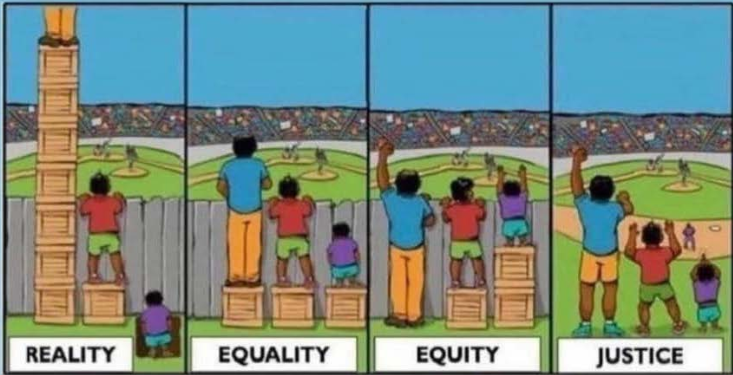
The critical flaw in this logic is that equity is not the same as equality. Equality means giving everyone the same thing. Equity means giving each person what they need to access the same opportunities. To treat people fairly, we must first see them accurately.
Consider a physical analogy: men and women, on average, have different physical strengths. This general difference doesn’t make women incapable of being exceptional soldiers or firefighters. It means we excel in diverse, equally vital ways. The goal is to create roles and supports that allow everyone to contribute their unique strengths.
Inclusion operates on the same principle. To include equity, we must sometimes provide different support to ensure an equal chance to participate and succeed. We install a ramp so a person who uses a wheelchair can enter the building just like everyone else. We provide closed captioning so a Deaf individual can access the video just like everyone else. We offer text-to-speech software so a student with dyslexia can comprehend the text just like their peers.
We don’t label someone a "ramp-user" or a "caption-needer." We recognize them as a full member of our community who needs one specific tool to participate fully. The support is a key, not a label.
Moving Forward: A Mindset of Capability and Action
So, what is the way forward?
- Listen to Individual Preference: When in doubt, ask how a person prefers to be identified.
- Use Respectful General Language: Terms like "people with disabilities" or "differently abled people" keep personhood at the forefront.
- Cultivate the Right Mindset: This is the most crucial step. See the person first. Assume capability. Understand that providing a different tool or path isn’t special treatment, it is the very essence of fair treatment.
Ultimately, belonging does not come from pretending we are all the same. It grows from valuing each other’s unique strengths and intentionally creating communities where everyone has the specific support they need to shine. Let’s move beyond labels that limit and focus on actions that include. Let’s choose our words with care, and more importantly, let’s ensure our spaces, our attitudes, and our hearts are open to the beautiful and necessary diversity of human ability.
For more articles and to book a professional development workshop for your school, please visit our Teaching For Success website www.teachingforsuccess.ca.