Beyond the School Gate: Moving from Reaction to Action on Student Excursion Safety
By Rosa Kemirembe - Teaching For Success
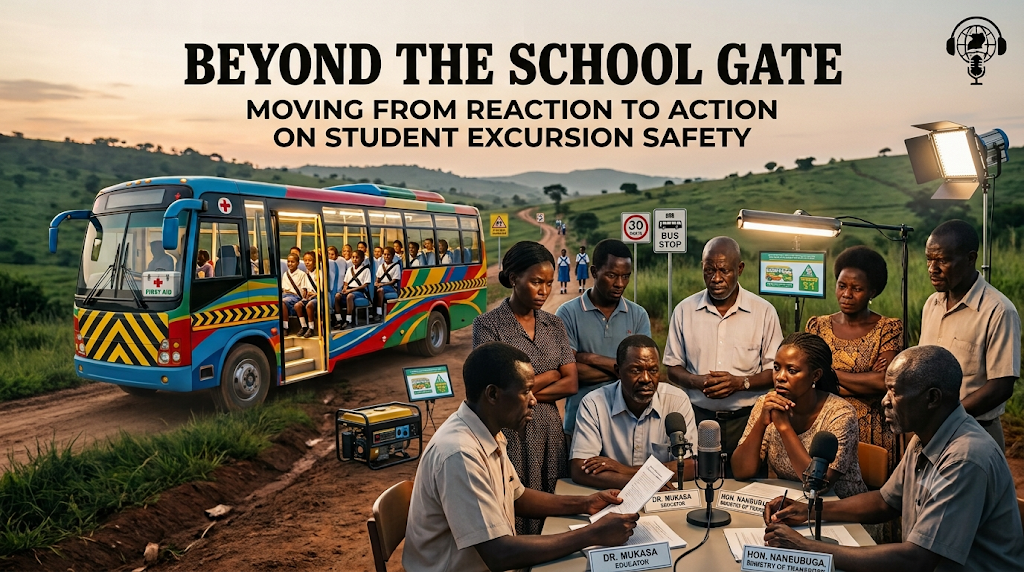
Every morning, millions of Ugandan parents perform an act of profound trust. They hand over their children, their most precious treasures, to school staff, believing with their whole hearts that safety is the absolute priority. When a child boards a school bus for an excursion, that trust extends beyond the classroom walls and onto Uganda's busy, often unforgiving roads.
But in recent years, that trust has been shattered. The tragic deaths of several students on a school trip have left families devastated and a nation asking painful questions. These were not just statistics. They were sons and daughters, classmates, and young souls with futures stolen far too soon.
We have mourned. We have held vigils. We have offered condolences. But mourning without action is empty. It is time to move from being reactive to proactive. It is time to stop waiting for the next tragedy to shake us awake.
The Missing Piece: Where Are the Health and Safety Inspectors?
When we talk about school safety in Uganda, our minds often jump to academic inspectors checking school licenses, syllabi and teacher qualifications. But what about health and safety inspectors, professionals with genuine expertise in fire safety, environmental hazards, transportation protocols, and emergency preparedness?
These experts should be visiting schools regularly, not government ministers, even with the right intentions but people with the right expertise for the job, to conduct thorough, unannounced reviews. They should be examining the following in collaboration with the Ministry of Education, Ministry of Health, Ministry of Transportation and Ministry of Water and Environment:
- Fire evacuation routes and extinguisher functionality.
- Building structural integrity and environmental risks.
- Canteen hygiene and food safety standards.
- Most critically, transportation safety protocols for excursions.
Currently, inspections are inconsistent. Some schools receive visits; many do not. Protocols exist on paper but are rarely enforced. This patchwork approach costs lives. Also, collaboration between different ministries is important.
The government must allocate sufficient funding to ensure that all schools, especially UPE schools, are safe. Overcrowding is a massive challenge. The more students packed into a classroom or a bus, the harder it is to keep them safe. If we cannot manage safety in numbers, we must reduce the numbers or increase the resources. There is no middle ground when a child's life is at stake.
Why Excursions Matter (Yes, Even the Fun Ones!)
Before we dive into safety protocols, let us be clear: school excursions are not the enemy. They are a vital part of a child's education. They offer exposure to the world beyond textbooks, history comes alive at heritage sites, science is visible in nature, and social skills are sharpened through shared experiences.
And let us not forget the importance of fun. Who decided that every school trip must be purely academic? Play, joy, and adventure are essential for children's social-emotional wellbeing. As the old saying goes: "All work and no play makes Jack a dull boy."
Children need to laugh, explore, and create memories. The goal is not to ban excursions, it is to make them safe enough that parents can feel confident, not fearful, when signing that permission form. However, a temporary ban until safety for school excursions is reconfigured by the authorities is vital.
Rethinking Transportation: A Checklist for Survival
The majority of fatal incidents on school trips involve vehicle accidents. This is where we must focus our most urgent attention. Below is a comprehensive strategy for safer student transport.
1. Approved Buses, Regularly Audited
Schools must only use bus companies approved by the Ministry of Education. But approval cannot be a one-time stamp. These companies should be regularly audited by an independent body, not affiliated with the school or the bus company, to ensure compliance with all safety standards.
2. Road-Worthy Vehicles
Every bus used for a school trip must be mechanically sound. This is not negotiable. Before any journey, the following must be checked and documented. This list is by no means exhaustive:
- Tire tread depth (not bald or worn).
- Brakes (tested for responsiveness).
- Engine and motor fluid levels.
- Indicators, headlights, wipers, and side mirrors (all fully functional).
A bus that cannot pass a basic roadworthiness test has no business carrying children.
3. Evacuation Exits That Are Actually Accessible
Buses must have evacuation exits at the back and on the roof. These exits must be clearly marked and never blocked* by chairs, luggage, or students. In an emergency, every second counts. A blocked exit is a death trap.
4. Seating That Protects, Not Harms
Each child must have their own seat*. Overcrowding is unacceptable. If Uganda manufactures buses locally, we must ensure that seat heights are designed to prevent children from being thrown forward in a head-on collision. Properly designed seating can mean the difference between a scare and a fatality.
5. Experienced Drivers for All Terrains
Driving a bus full of children is not the same as driving a matatu. Drivers must have proven experience on different terrains, from paved Kampala roads to muddy rural routes, and must be trained to handle adverse weather conditions. Driver fatigue must be managed with scheduled rest breaks.
Empowering Teachers and Students
A bus is only as safe as the people on it. Teachers and students must be active participants in their own safety. There should be at least one teacher for every 20 students on any excursion. This ratio ensures proper supervision, easier headcounts, and quicker emergency responses. Every teacher accompanying a trip must have current First Aid and CPR certification. In a medical emergency, the difference between life and death is often the first few minutes. Teachers must be equipped to act.
Bus Safety Presentations, Practical, Not Theoretical
At the start of each school year, every student, regardless of age, should receive a bus safety presentation. But presentations are not enough. They must be practical. Students should practice:
- Evacuating a bus under teacher supervision.
- Gathering at a safe assembly point far from the road.
- Staying calm and waiting for instructions, not running into traffic in panic.
Older students in secondary school should go further, they should be taught First Aid and CPR. At least two students on every high school trip should have this knowledge and certification in case teachers are injured and unable to help.
Discipline on the Bus
Children must understand that standing on a moving bus is forbidden. They must remain seated at all times. Additionally, while singing and excitement are natural, excessive noise can distract the driver. A calm, orderly bus is a safer bus.
Planning Ahead: The Trip Starts Long Before Departure
Safe excursions are planned, not improvised. Before any trip, school staff must:
- Map the route and identify the nearest clinics, hospitals, and emergency services along the way.
- Check the weather forecast and assess if the terrain is safe.
- Conduct a headcount before departure and upon arrival at every stop.
- Collect signed parental consent forms that include:
- Parent/guardian contact numbers.
- Child's doctor name and contact.
- Emergency backup contact if parents are unreachable.
- Document all student health conditions, asthma, seizures, allergies, etc., and have clear protocols for each.
Parents should also be encouraged to volunteer on trips. An extra pair of trusted hands is always welcome.
Washroom and Meal Breaks
The plan stops at safe, clean locations for washroom breaks, hydration, and food. Dehydrated, hungry, or uncomfortable children are distracted children, and distraction leads to risk.
Accountability: From the Top Down
At the end of the day, the Ministry of Education is fully accountable for enforcing all safety policies. This is not a burden, it is a duty. Policies that cannot be enforced are bad policies and must be scrapped and rethought.
Similarly, the Ministry of Transportation must work hand-in-hand with the Ministry of Education to enforce road safety regulations for school transport. Road accidents are already one of Uganda's biggest killers. When they involve children, the outrage is justified, but outrage must translate into action.
A Ugandan Problem: Our Tendency to Forget
Let us be honest with ourselves. As Ugandans, we are quick to grieve and even quicker to forget. A tragedy dominates the news cycle for a week, then life returns to normal, until the next accident.
We cannot afford this amnesia. We must learn to plan ahead and anticipate situations that could harm students. We must create enforceable strategies that work. If a policy cannot be enforced, it is worse than useless, it is a dangerous illusion of safety.
Giving Parents the Right to Choose
Not every child should be forced to go on every excursion. Parents should always have the option to opt out without stigma or penalty. If a child stays behind, the school should provide fun, meaningful alternative activities so that the child does not feel punished.
Children must also learn a valuable life lesson: You cannot always get what you want. Sometimes your parents say no, even when your friends' parents say yes. That is part of growing up. Excursions are not entitlements; they are privileges that must be earned and safely delivered.
Our Sincere Condolences and Our Resolve
To every family that has lost a child or loved one in these heartbreaking accidents, we offer our deepest condolences. Your loss is our loss. Your pain is our pain.
But we cannot let your children have died in vain. One life is too valuable to lose, let alone a child's life cut tragically short.
It is our hope that the appropriate governmental bodies are working hard behind the scenes to put the right structures and policies in place, even as they temporarily ban excursions. We understand the need for a pause. But a pause must be filled with purposeful action, not empty bureaucracy.
Final Thought
We want Ugandan parents to be confident, not fearful, when their child boards a bus for a school trip. We want children to return home, and with stories, not scars. Excursions should be remembered for the laughter and learning, not for the tragedy.
The blueprint for safety exists. The expertise exists. What is missing is the will to implement, enforce, and sustain these measures.
Let us wake up. Let us learn the hard lessons. And let us build a future where every school trip ends with a safe journey home.
Together, we can protect Uganda's future, one child, one bus, one policy at a time.
For more articles like this, visit our website: https://teachingforsuccess.ca